|
Prosticks Articles
Hong Kong Economic Journal --- 4 Dec, 2000
Be Cautious of False Breakouts for Moving Averages
Moving average is one of the most popular technical
analysis tool used by practitioners. Conventional wisdom
dictates that when price closes above the Moving Average,
one should go long. On the other hand, when price closes
below the average, one should go short. In the long run,
this is a very profitable strategy. However, at times when
the market is consolidating, price tends to fluctuate
above and below the average randomly, causing the strategy
to suffer from losing streaks.
Nevertheless, the Moving Average is a very useful
benchmark of support and resistance levels. When price
breaks above or below it, it means the resistance or
support is breached and a trend should then follow.
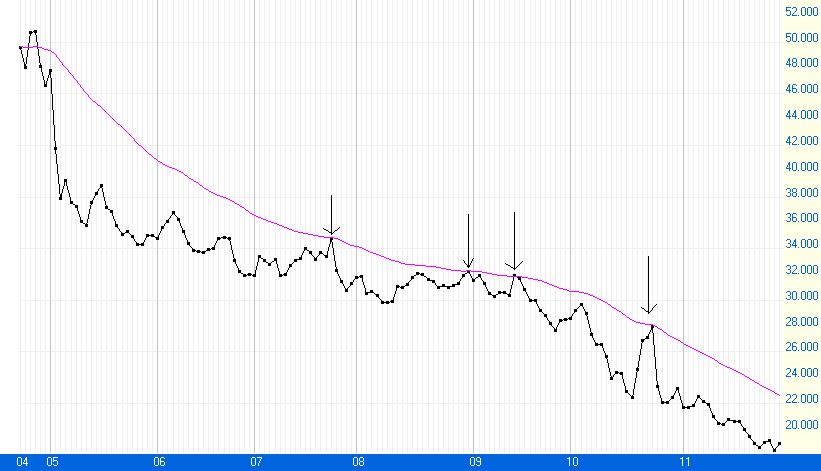
Figure 1 shows the Modal line chart of AT&T
(Symbol: T). AT&T is the biggest telephone company in
US, just like the PCCW in Hong Kong. Compared to the
historical high of 62, the current price level has already
dropped nearly 70%. The 40-day exponential moving average
is also shown in the figure. However, unlike the
traditional moving average, the moving average in the
diagram is calculated using Modal Points instead of
closing prices. The official Prosticks website allows the
users to specify whether to calculate the moving average
using closing prices or Modal Points.
It seems that there is a regional preference with
regards to the choice of Moving Average parameters. In
Hong Kong, people like to use 50-day Moving Average, while
in the United States, 40-day is more preferred than
50-day. There is no theory to account for the cultural
differential, just a regional custom.
Refer to Figure 1 again, notice how powerful the Moving
Average acts as a resistance level to the downtrend.
Whenever price rebounds from a low price to the Moving
Average, severe selling pressure resurfaces and the
downtrend resumes. (see the places marked with arrows in
the figure).
Thus, from this chart, we see that the Moving Average
has been imposing significant resistance to price all the
way throughout the downtrend. We should then deduce that
the average should continue to act as a resistance to
price in the future. As such, not until the subsequent
Modal Points can manage to break above the average, the
trend is still down.
Though the Figure shows that the Modal Points never
rise above the average, if we look at the Candlestick
chart of this stock (not shown here), we will see that at
times the day high or close of some bars temporarily
breaks the average, creating false breakouts? Thus, if one
adopts the Moving Average breakout strategy in trading,
one should wait until the Modal Point breaks the average,
rather than merely the day high or day close.

|