|
Prosticks Articles
Hong Kong Economic Journal --- Aug 7, 2000
Trend Following
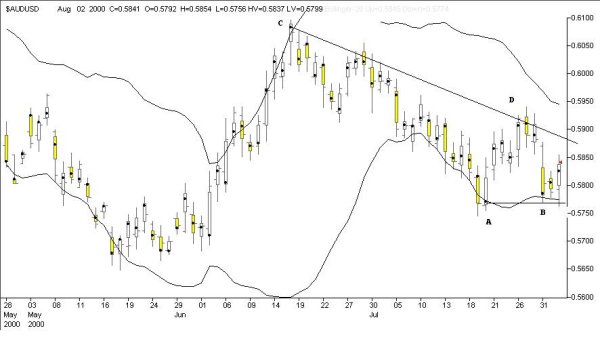
The figure shows the Prosticks chart of Australian
dollar. Let us use it to perform a forecast of the
currency.
First, take a look at the three bars at B. As
can be seen, three days in a row at B, price cannot
break below the Modal Point of A, which is the
previous low. This shows that after a prolonged downtrend,
bargain hunting started coming in. These buying forces
were initiated at A. Apparently, they resurfaced at
B.
Coincidentally, the lower Bollinger Band also occurs at
the price level similar to the Modal Point of A.
Bollinger Bands is a widely used technical tool in the
United States and is gaining much popularity in Hong Kong
recently. According to the theory, if the distance between
the upper and lower bands (the bandwidth) starts widening
and price closes above the upper band or below the lower
Band and, a trend results. Otherwise, price oscillates
between the upper and lower band.
Thus, we can see that at B, there are two layers
of support for prices: The Modal Point of A, and
the lower Bollinger Band, occurring at similar price
level. The fact that three days in a row price cannot
break through this support cause us to deduce that a
bottom is forming at the support level.
It is very dangerous to try picking market tops and
bottoms in tradings. Always trade in the direction of the
trend. Remember the famous proverb which goes trend is
your friend? Thus, even though we suspect the market
bottoms out at B, unless we see an emerging uptrend,
we should refrain ourselves to jump on board so quickly
when the prevailing trend is still down.
So when should we go long? Trendlines can offer a clue.
Trendlines are a tool used to signify the change in
direction of a trend. When the market rises above a
resistance trendline, an uptrend is expected. Conversely,
a downtrend results when a support trendline is broken
from above.
Traditional trendlines are drawn using previous highs
and lows. In our Prosticks chart, we draw the resistance
trendline using the Modal Points of the previous highs and
lows instead. Drawing trendlines using Modal Points make
more sense because Modal Points represent the genuine
market forces. Highs and lows represent only two trading
instances of the whole day. Modal Points, on the other
hand, is the price which all the market players have
agreed to trade given all the economic and political
conditions of the whole day.
As can be seen from the figure, a resistance line is
drawn using the Modal Points of C and D. If
price rises above this line, we can be confident that the
market really bottoms out at B and an uptrend is
confirmed. We will then long the currency. On the other
hand, if the buying forces at B are weak and are
only transitory, the market should not have enough
strength to propel price upwards enough to break the
resistance trendline. In this case, we would not have
longed the market.

|