Dec 19, 2025  10:56:17 PM HKT

TourSiteMapFAQsAboutContact
Home QR  Forex TV 
UsernamePassword
SavePW
sp

  Home > Education > Articlespatentsp
  
sp
sp
sp
articles
 

Prosticks Articles

Apple Daily --- 15 Oct, 2000

Fibonacci Ratios Using Modal Points

Last week we talked about how fibonacci numbers could magically predict market turning points. We explained that after a prolonged trend (whether up or down), retracement will occur which usually ends at either 0.382, 0.5, or 0.618 of the amplitude of the previous trend. We also mentioned that when one of these fibonacci retracement levels coincide exactly with a nearby Modal Platform, the probability that the retracement will stop at that level is very high.

The three levels of the Fibonacci ratios work this way. Suppose after undergoing an uptrend, the market becomes wary and a correction occurs. We would first expect the market to fall to the 0.382 level before finding a support. If the 0.382 support is broken, we will the expect the market to continue falling until the 0.5 level is tested. If the 0.5 level is broken also, 0.618 will be the final frontier. Traditionally, Fibonacci traders will consider that if the market breaks the 0.618 level, the previous uptrend will vanish and a bear market has subsided. Similarly, if a rebound of a previous downtrend shoots past the 0.618 level from below, the downtrend is no longer be valid and the current rebound can be viewed as a fresh new uptrend.

Thus, if we examine the evolution of price movements dated a long time ago and keep track of all the 0.618 levels on the way, we should have a clear picture what kind of trend we are currently in. Our final interpretation really depends on how long the data we look at. Consider a falling market. If we use only nearby data, we may interpret the falling market as a downtrend since it may have broken all the 0.618 levels of the nearby low/high pairs. However, if we add more data to our sample, we may discover that the falling market may in fact be only be a correction phase of an uptrend which starts many days or months ago. The falling market may not even surpass the 0.382 level of this distant uptrend yet!

How long data we should consider depends on our trading horizon. If we are short-term players, we should use nearby data and identify all the fibonacci levels of the nearby high/low pairs. If we are long-term investors, then we should use more distant high/low pairs to compute our fibonacci levels and determine what trend we are in. In the latter case, we may even want to look at weekly or monthly charts and compute fibonacci levels based on them.

Irregardless of whether we are short-term or long-term players, remember one thing: Never trade against the trend. Remember the proverb trend is your friend? Trendlines and Fibonacci levels are very useful indicators of determining what kind of trend the market is in.

Traditional Fibonacci levels are computed using high and low pairs. Readers should now agree that Fibonacci levels calculated this way may not be reliable sometimes since the high and low price are subject to manipulation or market overreaction. Modal Points are more reliable and accurate market parameters. Thus, Fibonacci levels should be calculated using Modal Points.

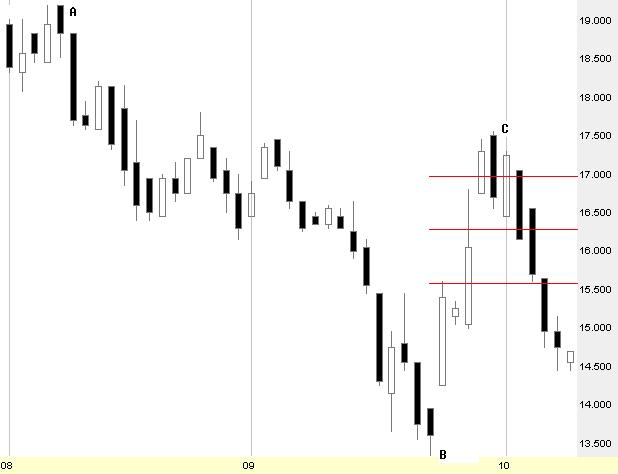
Figure 1 shows the Candlestick chart of Johnson Electric Holdings (0179). As can be seen, from A to B, the market underwent a prominent downtrend. Then dramatically, the market struck a fierce rebound within a week and pushed up the market from B to C. Notice that at C, the market closed above the 0.618 level. Fibonacci traders would then have concluded that an uptrend was underway. Unfortunately, after the powerful rebound, the bears emerged again and within another week, most of the rebound were wiped out. This is a sign of technical trap?

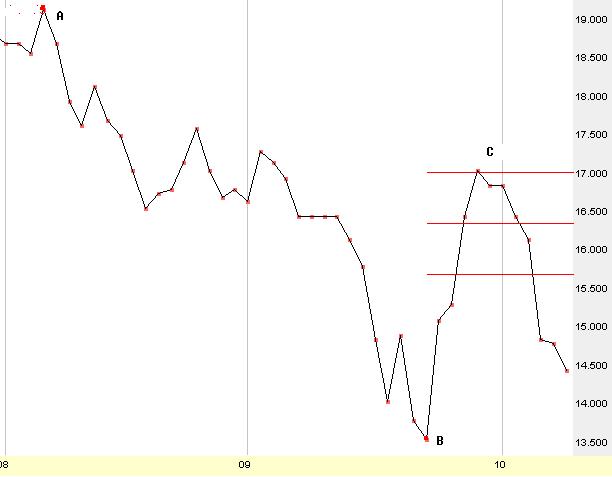
Figure 2 shows the Modal line chart of Johnson Electric. Notice that if we measure Fibonacci levels using Modal Points instead of high and low, the Modal Point of C in fact lied exactly at the 0.618 level of the Modal Point of A and B. Thus, while the traditional Fibonacci levels suggest that the downtrend of A to B is over after the BC rebound broke the 0.618, Modal Point Fibonacci levels simply say not Yet?

Of course, there are many cases in which traditional Fibonacci levels computed using high/low prove to be very accurate. However, we should watch out for divergence. That is, if the traditional Fibonacci level is broken but the Modal Fibonacci level still holds, then one has to be cautious when predicting the state of market.


sp
agreementspprivacysppatent
sp
sp
sp
sp

Copyright© 2025 ProSticks.com Limited. All rights reserved. ProSticks.com Limited, Hong Kong Exchanges and Clearing, HSI Services Limited, endeavor to ensure the accuracy and reliability of the information provided but do not guarantee its accuracy or reliability and accept no liability (whether in tort of contract or otherwise) for any loss or damage arising from any inaccuracies or omission. Currently, all Hong Kong stock and index quotes are at least 15 minutes delayed. Currency and commodity quotes are all 10 minutes delayed. All others are updated irregularly.