Feb 11, 2026  5:03:02 PM HKT

TourSiteMapFAQsAboutContact
Home QR  Forex TV 
UsernamePassword
SavePW
sp

  Home > Education > Articlespatentsp
  
sp
sp
sp
articles
 

Prosticks Articles

Apple Daily --- 10 Sept, 2000

Market Prediction with Modal Count

Last time we discussed the time approach to calculate Prosticks parameters. Under the time approach, the Modal Point is defined as the price which the market has spent the most time trading. It is not necessarily the price with the highest volume traded on it, but rather, the price which the market has traded with the highest frequency. We also explained that Modal Points calculated using the time approach have more predictive power since they do not have the deficiencies of the volume approach.

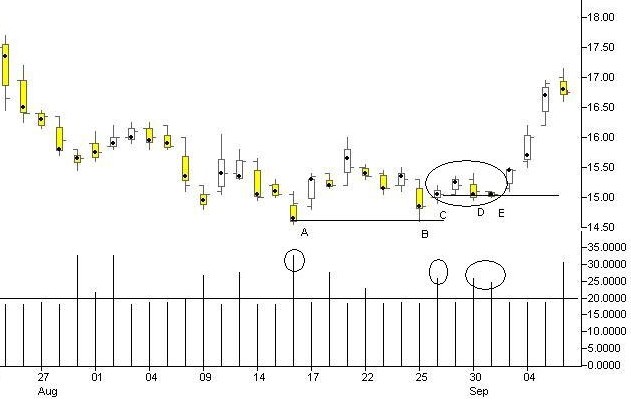
Prosticks charting has an indicator called the Modal Count which records the amount of time the market spends trading at the Modal Point. Refer to Figure 1 which shows the Prosticks chart of SmarTone(0315). The upper pane shows the conventional Prosticks chart while the lower pane shows the corresponding Modal Count indicator. As can be seen, the Modal Count plot looks similar to the traditional volume plot. The vertical lines represent the number of 5-minute intervals the market has spent trading at the Modal Points. Thus, if the Modal Count for a day is 20 units, it means that during that day, there are 20 five minute intervals the market has traded at least once at the Modal Point. The horizontal line in the plot is the 150-day average of the daily Modal Count. Thus, if the Modal Count is above the 150-day average, it means the market has spent more than a normal amount of time trading at the Modal Point.

Remember, the Modal Point is the price where the bulls and bears trade actively with each other. The more time the market spends at the Modal Point (and thus the higher the Modal Count), the more severe is the tug-of-war between the two parties.

Refer to Figure 1. Notice that bar A has an exceptional high Modal Count. That day, the Modal Point is located at the bottom of the bar and finally the market rallied all the way up and closed above the Active Range and Modal Point. The large Modal Count value signals that the market had consolidated a long time at day low before finally the buying forces exhausted all the selling forces and propelled price strongly upwards. Market bottoms often behave like this. As can be seen from the figure, when a few days later, price fell to A's Modal Point again at B, those buying forces at A resurfaced and pushed price upwards from B.

Consider the bars circled in the figure. Notice that bar C, D, and E all have the same Modal price, forming a Modal Platform. Notice that all their Modal Count have high values, higher than those of their nearby bars as well as above the 150-day average. Therefore, we know that there was a fierce battle taken place between the bulls and the bears at C, D, and E three days in a row at the same price. When we see this phenomena, we know that once either the buy or sell side is exhausted, the market will explode in either way. Notice that all of the Modal Points at C, D and E reside inside the Active Range of B, another indication of an extreme tight market situation. As expected, the next day after E, the market opened above the Modal Platform and then surged dramatically over the next few days.

Thus, on market tops or bottoms, when streaks of high Modal Count values occur, a correction or rebound is near.

Please note that the Modal Count indicator can only act as a supporting reference. Unlike traditional indicators such as RSI or Stochastics, the Modal Count indicator contains much noise and thus should be used with caution. Suppose during a day, the market is extremely quiet and inactive ahead of holiday with little news, price should then trade in a very tight range. In this case, the Modal Count will also be very high, but without much significant implications. Modal Count concepts only apply to trending markets, especially when the market is near the top or bottom.

The Modal Count concept can also be used to predict the Modal Point of the whole day. To give an example, suppose the 150-day Modal Count average is 20 units. On a day, we see that the Modal Count is already 30 units and the intraday Modal Point is at $13. In this case, even though the market is not closed yet, we can comfortably conclude that for the rest of the day, the Modal Point will remain at $13. For those who want to range trading, they can use $13 as the benchmark center point to buy low? and sell high?


sp
agreementspprivacysppatent
sp
sp
sp
sp

Copyright© 2026 ProSticks.com Limited. All rights reserved. ProSticks.com Limited, Hong Kong Exchanges and Clearing, HSI Services Limited, endeavor to ensure the accuracy and reliability of the information provided but do not guarantee its accuracy or reliability and accept no liability (whether in tort of contract or otherwise) for any loss or damage arising from any inaccuracies or omission. Currently, all Hong Kong stock and index quotes are at least 15 minutes delayed. Currency and commodity quotes are all 10 minutes delayed. All others are updated irregularly.