|
Prosticks Articles
Apple Daily --- 27 Aug, 2000
Trace of Market Bottomed-Out
Prosticks charting applies to all kinds of stocks,
bonds, and currencies for all markets. Today, let look at
how Prosticks charting can be applied to analyzing US
stocks.
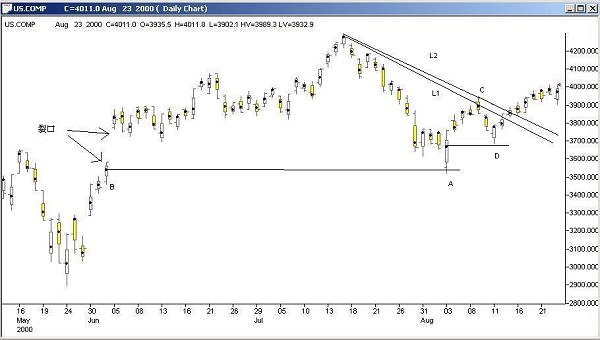
Figure I shows the Prosticks chart of the Nasdaq
Composite Index. As can be seen, after making the high at
around 4200 in mid-July, price underwent a correction. The
correction stopped at A, which coincided with the
Modal Point of B. Why the correction stops at A ?
Well, notice that at B, there is large gap.
According to technical analysis theory, a correction
usually fills the gap before the prior uptrend resumes.
Obviously, at A, after filling the gap, buying
orders flushed into the market pushing price upwards.
These buying orders were originated at the Modal Point of B
which is the bar forming the gap.

Take a look more closely at A. Notice that A
gaps down significantly from the previous bar but
subsequently rises strongly upwards, closing at the high.
In candlesticks theory, this is a very bullish piercing
pattern? This pattern usually signifies a market bottom.
Thus, at A, when we saw (1) a piercing pattern (2)
a gap being filled, and (3) the low coincides with the
Modal Point of the gap formation bar B, we should
have been able to deduce that the market bottomed out at A.
From A, price rebounded to C and then
another another minor correction occurs. This time, the
minor correction stops at D which has the same
price as the Modal Point of A. Obviously, the
buying orders originated at A resurfaced at D
at similar levels. As said before, these buying orders
actually could be backtracked back to the Modal Point of B.
Having said that, should we buy after the market closed
at D? Remember the proverb which goes trend is your
friend? Even though we speculate that there are buying
orders supporting the market at A and D, not
until an uptrend is confirmed, we should not be in a hurry
to rush into the market.
Trendlines are an effective tool to gauge the trend of
the market. When price breaks a resistance trendline, an
uptrend occurs. When price falls below a support trendline,
a downtrend results.
Thus, while we think that the market bottoms out
at D, we should draw a resistance trendline and go
long only when price indeed rallies above it.
As shown in the figure, L2 is the resistance
trendline using the traditional approach of connecting two
nearby high points together. On the other hand, L1
is the resistance trendline which connects the Modal
Points, instead of the high points together. As can be
seen, the Modal Point trendline L1 has an earlier
entry point than the traditional trendline L2.
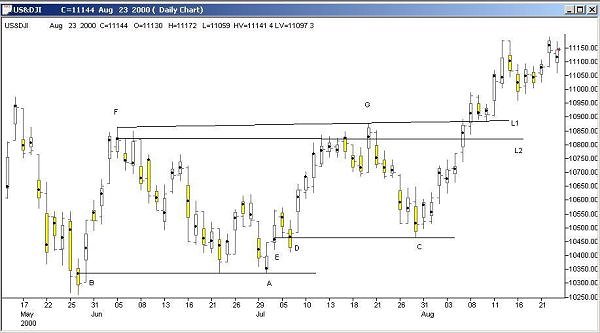
Figure 2 shows the Prosticks chart of Dow Jones
Industrial Average. Similar Prosticks concepts which we
have been discussing can be applied to it.

First, notice that the market bottom at A
coincides with the Modal Point of B. Why B
is important? It is because it is the nearby major market
bottom. Thus, a lot of buying orders had resided at its
Modal Point which resurfaced when price retest it at
similar level at A. Similarly, notice that the low
point C lies on the Modal Platform formed by the
Modal Points of D and E.
Two trendlines are shown. The first L1 is formed
by connecting the high points of F and G
together. The other one, L2, is formed by
connecting the Modal Points together instead. As can be
seen, once again, the trendline formed by Modal Points is
better than the traditional one since it has an earlier
entry point.
|