Feb 11, 2026  5:02:46 PM HKT

TourSiteMapFAQsAboutContact
Home QR  Forex TV 
UsernamePassword
SavePW
sp

  Home > Education > Advantages of ProSticks® > Support and Resistancepatentsp
  
sp
sp
sp
ProSticks®
Support and Resistance
sp

Support and resistance levels, more often than not, coincide with a previous Modal Point, the most heavily transacted price for a particular time interval. Price levels where there have been the most buying and selling should be considered important, and where the analysis should begin. This should be intuitive to the technician.

But identifying which Modal Point is important and which is not takes time, experience, and careful analysis of the situation at hand. It is more an art, rather than a science. But we can start by focusing on the tops and bottoms we have been identifying with traditional technical tools.

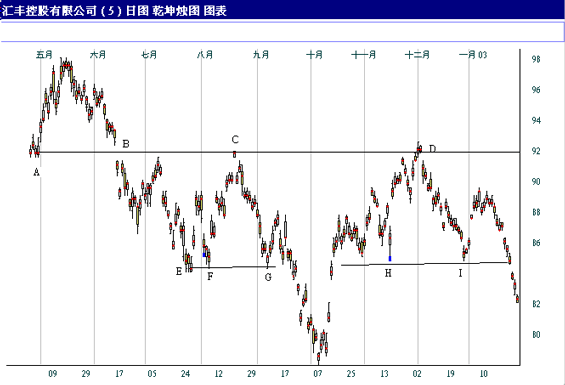
In the above example, the price began in the midst of a down-trend. At point A, the price gapped down at the open and continued its slide. The price rebounded a few days later and the first resistance it met was at point B. This resistance level just so happened to coincide with a previous Modal Point established a few weeks earlier. The price then sold-off once again but quickly found support a few days after and rebounded once more.

This time, at point C, the price was able to break the resistance level set by the previous Modal Point but the buying momentum dried up only shortly after and the price began its slide once again. At point D, the previous resistance level, now acting as a support, failed to offer any strength as the price gapped down at the open and the decline continued. Subsequent rebounds at point E and F also failed to break the resistance level established by the previous Modal Point.

Analyzing Modal Points allow the technician to correctly recognize the source of the strong resistance and/or support levels that were previously anonymous with either a bar or candlestick chart, even after-the-fact. By gaining more experience with ProSticks, a trader will be able to trade with more confidence.

As with traditional charting theories, focusing on a previous high or low can prove to be beneficial when attempting to identify potential support and/or resistance points.

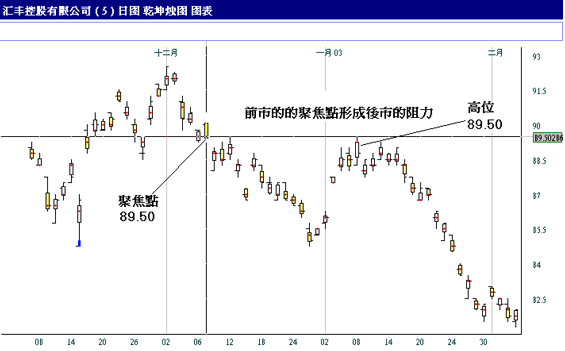
Historical tops (bottoms) are usually a source of significant resistance (support) for future price action. As the above example shows, one can use the Modal Point to forecast potential resistance as the price rallies off its lows. Traditionally, the high is used to forecast potential resistance but as can be seen with the above example, the price never reached the previous high.

It should be intuitive that the Modal Point is a more accurate level to forecast support and/or resistance levels because it is the price where the most number of transactions took place. For example, if a trader enters into a long position at the previous Modal Point and the price sold-off afterwards and the position was held, most traders would, at most, hope to break-even. So when the price bounces back, this would be where one would liquidate the position and thus, pose as a significant resistance for the bulls.

Moreover, in the above example, the majority of trading took place below the previous Modal Point. Although the price closed above the previous Modal Point for a few trading days, there was not a confirmation of a potential breakout the following day. Thus, as with all technical analysis tools, one should always wait for a confirmation signal before entering into a position.


PreviousNext
Contents

spIntro
sp
spHow ProSticks Can Help
sp
spSupport and Resistance
sp
spModal Platforms
sp
spTraditional Chart Patterns
sp
spCandlestick Patterns
sp
spIndicator Signals
sp
spAdvantages
sp


sp
sp

sp
agreementspprivacysppatent
sp
sp
sp
sp

Copyright© 2026 ProSticks.com Limited. All rights reserved. ProSticks.com Limited, Hong Kong Exchanges and Clearing, HSI Services Limited, endeavor to ensure the accuracy and reliability of the information provided but do not guarantee its accuracy or reliability and accept no liability (whether in tort of contract or otherwise) for any loss or damage arising from any inaccuracies or omission. Currently, all Hong Kong stock and index quotes are at least 15 minutes delayed. Currency and commodity quotes are all 10 minutes delayed. All others are updated irregularly.